
Three Forces Reshaping Special Education in 2026
Updated: Aug 10
If you're a parent navigating the IEP process or an advocate supporting families, 2026 is going to feel different. The ground has shifted in ways that matter.
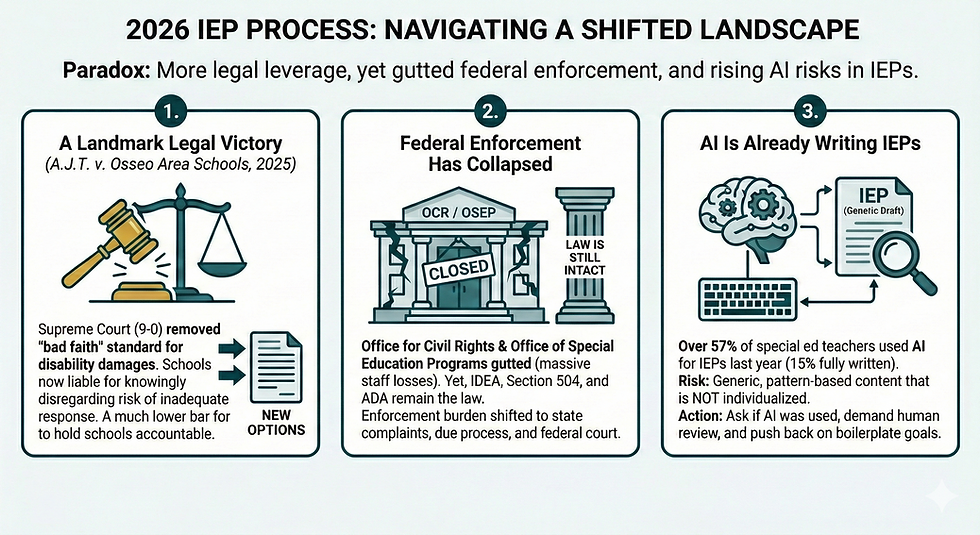
Here's the paradox: families have more legal leverage than at any point in recent memory, yet the federal agencies that traditionally enforced their rights have been gutted. Meanwhile, AI is quietly changing how IEPs get written, creating risks most people aren't equipped to spot.
A Landmark Legal Victory
The Supreme Court's June 2025 decision in A.J.T. v. Osseo Area Schools is the most significant win for families since Endrew F. in 2017.
In the federal circuits that had adopted the rule, families had to prove schools acted in "bad faith or gross misjudgment" to recover damages for disability discrimination. That was nearly impossible to meet, and it was never a nationwide standard. The split between circuits is exactly what sent the question to the Supreme Court. In a unanimous 9-0 ruling, the Court threw out that standard.
Now, schools can be held liable when they know about a student's needs and disregard the risk that their response is inadequate. That's a much lower bar. It changes settlement negotiations, litigation strategy, and how seriously schools take accommodation requests.
If your child has been harmed by a school's refusal to provide appropriate services, you may have options that didn't exist a year ago.
Federal Enforcement Has Collapsed
The Office for Civil Rights closed seven of twelve regional offices in March 2025. Of approximately 600 staff, only around 62 remain. The Office of Special Education Programs lost 121 of 135 employees in October.
But here's what hasn't changed: IDEA is still law. Section 504 is still law. The ADA is still law. Schools have the same legal obligations they had before. What's changed is who enforces them.
State complaint procedures, due process hearings, and federal court now carry the load. Filing OCR complaints still matters for documentation, even if investigations are delayed. The law is intact. The path to enforcement has shifted.
AI Is Already Writing IEPs
According to the Center for Democracy and Technology, 57% of special education teachers used AI for IEP development last year. That's up 18 points from the year before. 15% used AI to fully write IEPs.
The problem: IEPs are supposed to be individualized. AI generates content based on patterns, not your specific child. The result can be documents that look professional but contain generic goals and boilerplate language that doesn't actually address your child's needs.
At your next IEP meeting, ask whether AI was used and what human review occurred. Read the document carefully. If it sounds like it could apply to any student with a similar disability, push back.
What This Means for You
The legal toolkit has expanded. Federal oversight has shrunk. Technology is changing how schools work. All three are happening at once.
Understanding these shifts puts you in a stronger position to navigate them. We'll be releasing a comprehensive report digging deeper into each of these areas. For now, the takeaway is simple: the rules of the game have changed, and 2026 rewards those who adapt.


Comments